Technique
Learn the Muscle Snatch: Build a Faster Turnover
Learn the muscle snatch to build a faster, stronger snatch turnover, with the drill progression and the mistakes that defeat the exercise's purpose.
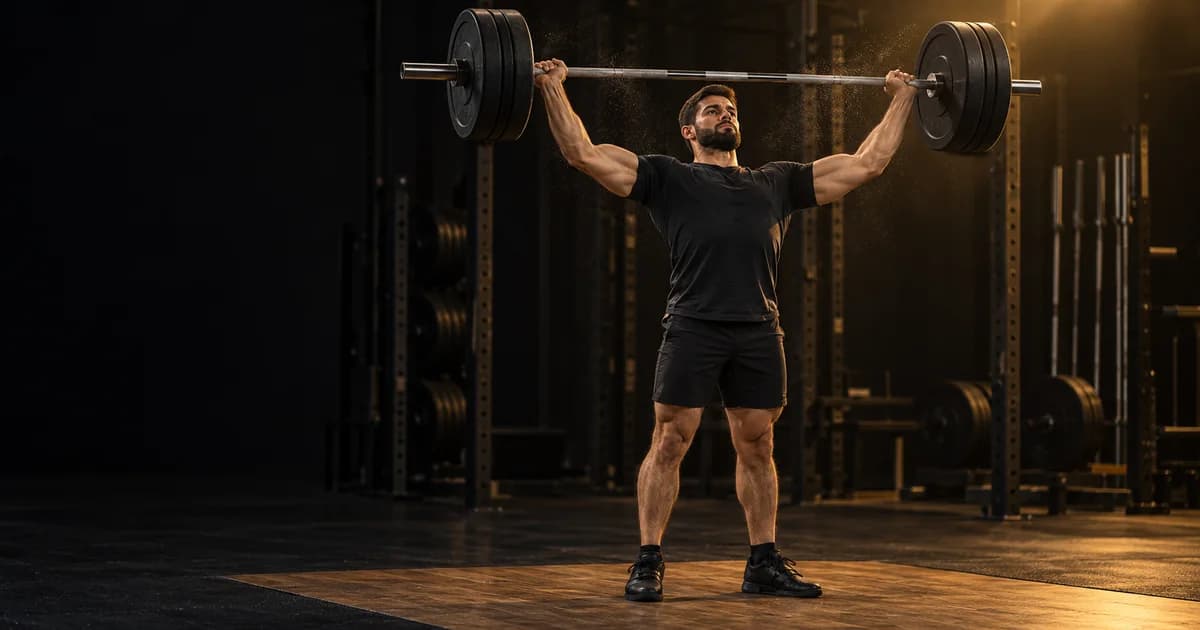
Learn the muscle snatch by pulling and turning the bar over with no dip underneath it, so your upper body alone performs the exact turnover motion a full snatch relies on speed and position to finish. Keep your elbows high, near shoulder height, as they move up and out before the turnover, since dropping them to press the bar up early defeats the whole purpose of the drill. Most lifters who struggle with their competition snatch turnover trace the problem back to this exact habit, which makes the muscle snatch one of the highest-value drills in a snatch program despite the light weight it uses. This guide walks you through the movement, a 4-step drill progression, and the mistakes that turn it into a glorified upright row.
Set your grip before you start
Use the same wide snatch grip you use on a full competition snatch instead of a narrower pulling grip. A grip that is too narrow shortens the distance your elbows travel outward and changes the pattern you are trying to reinforce. If your snatch grip width still feels like a guess, settle it before you add this drill to your warm-up.
Perform the muscle snatch in 3 steps
- Pull to the power position. Pull the bar from the floor or the hang up to roughly hip height, accelerating hard through this phase exactly as you would in a real snatch. Your back stays flat and your shoulders stay over or slightly ahead of the bar at this point.
- Drive your elbows up and out. Shrug your shoulders up and back while your elbows rise to the outside, staying level with or above your hands, never dropping below them. This is the single detail that separates a real muscle snatch from an upright row with extra steps.
- Turn the bar over and punch to lockout. Rotate your hands around the bar as your elbows continue rising, then finish by punching your arms straight up until they lock overhead. Keep pulling the bar up and back through the turnover instead of letting it drift forward in front of your face.
Build the muscle snatch with 4 drills
- Tall snatch high-pull. Standing tall with the bar already near your hips, pull your elbows up and out as high as you can without turning the bar over, squeezing your shoulder blades together at the top.
- Tall muscle snatch. From the same tall starting position, add the turnover: pull your elbows up and out, then punch through to a locked overhead finish.
- High-pull and muscle snatch complex from the power position. Add a vertical leg drive from the power position before the same upper body sequence, connecting your legs and your turnover in one movement.
- The same complex from the floor. Once the complex feels consistent, start it from the floor so the whole pull, drive and turnover run together as they will in a real snatch.
Keep the bar light through all 4 drills, often just the empty bar, since the goal is a clean pattern rather than a heavy lift.
Choose a starting position for your goal
| Variation | Starting point | Best for |
|---|---|---|
| Standard muscle snatch | From the floor | Full technique practice, including your first pull |
| Hang muscle snatch | From the hang, bar at knee or thigh height | Isolating the upper body turnover with less leg involvement |
| Muscle snatch from the power position | From the hips | Connecting a vertical leg drive to the turnover |
| Dip muscle snatch | From a slight dip at the hips, no leg drive | Reinforcing a vertical bar path into the turnover |
Rotate between these across a training block rather than running only one version. Each isolates a slightly different piece of the same pattern, and coaches commonly cycle through them across a training block so no single piece of the turnover goes untrained for long.
Avoid these common muscle snatch mistakes
| Mistake | What happens | Fix |
|---|---|---|
| Dropping your elbows early | You turn the drill into a press instead of a pull-driven turnover | Keep your elbows rising above your hands until the bar is fully turned over |
| Loading too much weight | Heavy weight forces exactly the pressing pattern the drill exists to remove | Use the empty bar or a light weight and focus entirely on the pattern |
| Flipping your wrists too soon | The bar loses the continuous pull the drill is meant to reinforce | Keep pulling the bar up and back until your elbows are fully extended behind it |
| Rushing straight to a heavy muscle snatch | You skip the drill progression that actually builds the pattern | Work through the 4-drill progression above before adding real load |
Fit the muscle snatch into your program
Use the muscle snatch as a technique primer early in a snatch-focused session, after your general warm-up but before your heaviest pulling or snatching work.
| Use | Sets and reps | Load |
|---|---|---|
| Learning the pattern | 3 to 4 sets of 3 to 5 | Empty bar only |
| Warm-up primer before snatching | 2 to 3 sets of 3 | Light, well under your lightest snatch warm-up |
| Strength and speed through the turnover | 3 to 4 sets of 2 to 3 | Moderate, only once the pattern is automatic |
This drill earns its place through quality of movement rather than volume or load, so resist the urge to chase a heavier number across sessions the way you would with a main lift.
Our how to learn the snatch guide places the muscle snatch inside a full beginner progression, and snatch balance technique covers the companion drill that builds your receiving position the same way this one builds your turnover. Once both feel solid, power snatch and hang snatch give you the next steps toward a full competition snatch.
Common questions
What is the point of the muscle snatch if you cannot lift much weight?
The muscle snatch trains the exact turnover pattern a full snatch depends on, isolated from the speed and dip that normally hide a weak or late turnover. Light weight is the point rather than a limitation.
How much weight should you use for a muscle snatch?
Most lifters use the empty bar or a very light plate-loaded weight. If you need to drop your elbows or press to finish the rep, the weight is already too heavy for the drill to do its job.
Is the muscle snatch a beginner or advanced exercise?
Both. Beginners use it to learn the turnover pattern from scratch, and advanced lifters use the same drill at heavier bar speeds to reinforce and strengthen a turnover that already works.
How is a muscle snatch different from a snatch high-pull?
A high-pull stops once your elbows reach their highest point, with no turnover. A muscle snatch continues that same pull into a full turnover and overhead lockout.