Training guide
Olympic Weightlifting for Beginners: Your First 8 Weeks
Learn the start, power and catch positions, follow an 8-week beginner plan with sets, reps and percentages, and see what the injury research says.
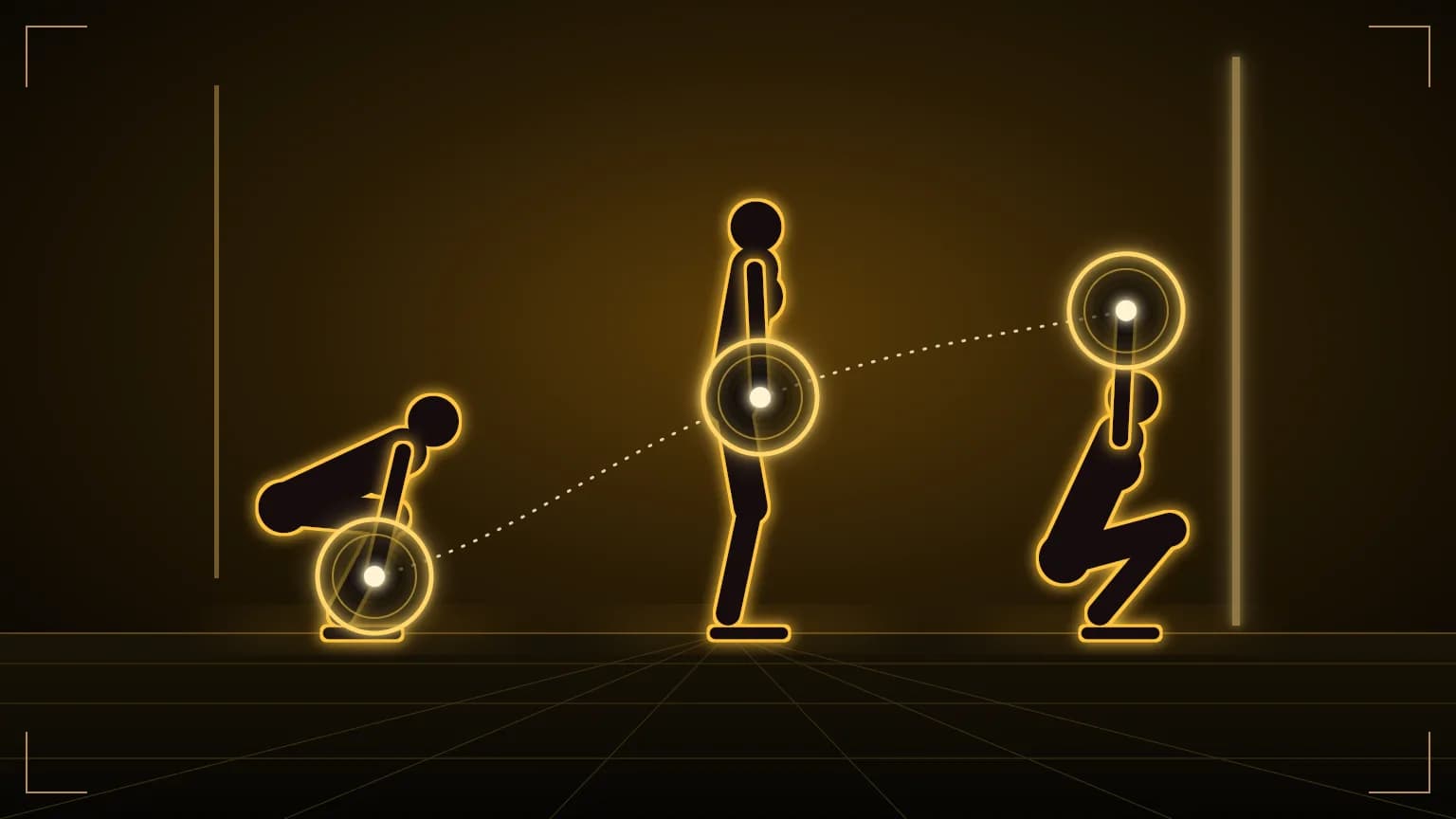
Start Olympic weightlifting with an empty bar, three sessions a week and a coach who watches you, and spend your first 8 weeks on three positions before you chase weight: the start, the power position and the catch. Build each lift from the top down, hips first, then knees, then the floor, keep your heavy sets at 65 to 75% of your best technical single, and test yourself in week 8 so you begin a full program with real numbers.
Below you get the three positions drawn out, the order that teaches each lift, a week-by-week plan, the injury numbers from the research and the beginner mistakes worth fixing first.
Know what the two lifts ask of you
The sport has two lifts, and you take them in a fixed order. The snatch moves the bar from the platform to locked arms overhead in one movement. The clean and jerk takes two: the clean brings the bar to your shoulders, then the jerk drives it overhead. The IWF Technical and Competition Rules give you three attempts at each lift, and your best snatch plus your best clean and jerk make your total.
Two rules shape your training from day one. A press-out, where your arms keep straightening after you reach the bottom of your squat or split, makes the snatch or the jerk a no lift. In the clean, the bar may not touch your chest before it settles on your shoulders. So you practise fast, locked catches from the first session and never let a slow press finish a rep. The men's bar weighs 20 kg and the women's bar 15 kg. For the phases of each lift and the main variations, read the Olympic lifts guide.
Learn the three positions before the lifts
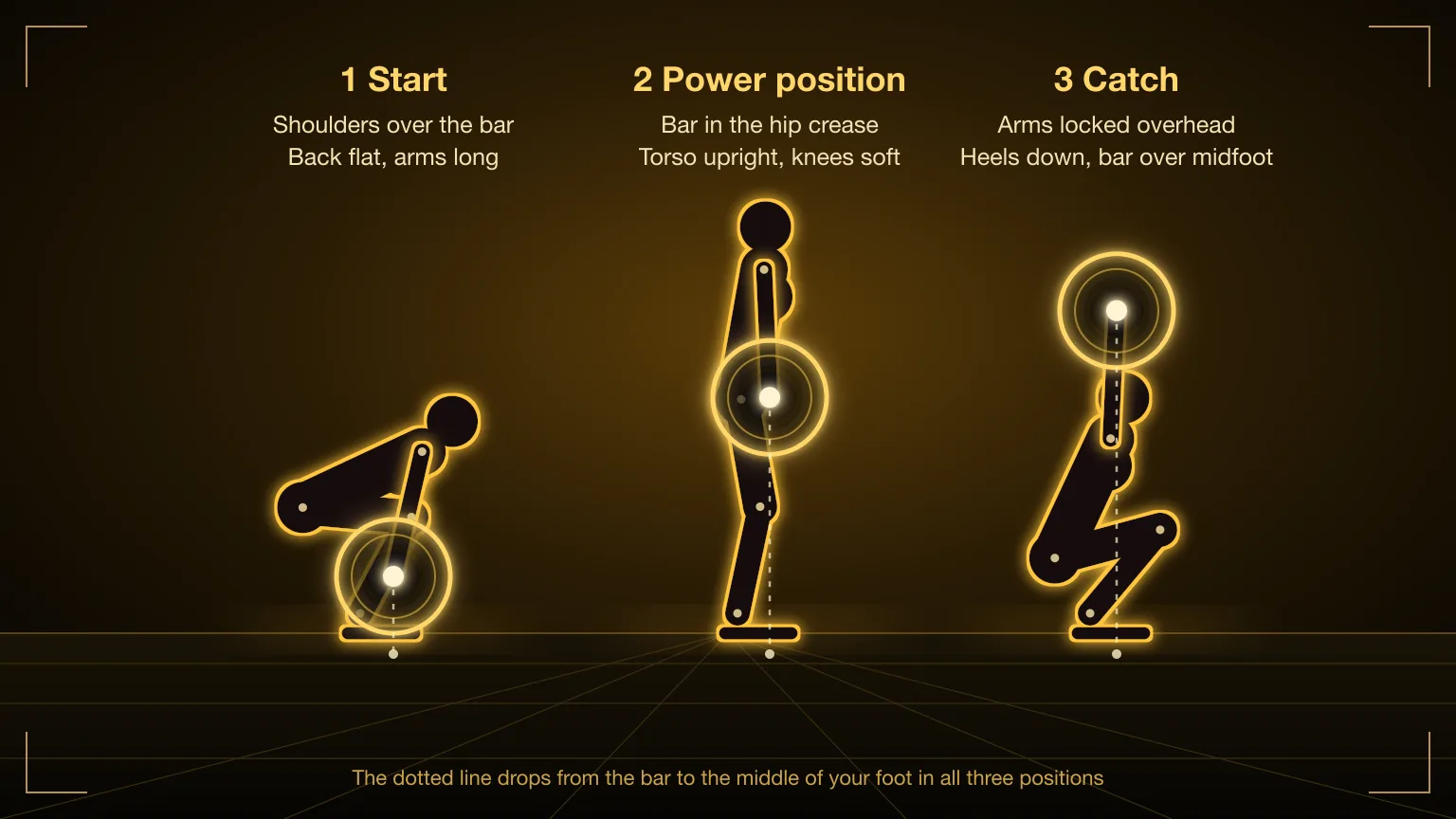
Every snatch and every clean passes through the same three positions. Learn them with a PVC pipe or an empty bar, hold each one for 3 seconds, and the full lifts become far easier to put together.
Set the start
Stand with your feet about hip width apart and the bar over the middle of your feet, close enough that your shins touch it when you bend your knees. Grip the bar, keep your arms long and your back flat, and let your shoulders sit slightly in front of the bar. For the snatch, widen your grip until the bar sits in the crease of your hips when you stand tall with straight arms. For the clean, put your hands just outside your shoulders.
Find the power position
Stand tall with the bar, soften your knees and slide your hips back a few centimetres until the bar rests in the crease of your hips for the snatch, or high on your thighs for the clean. Your torso stays close to vertical, your weight spreads over your whole foot and your arms hang long. Every pull from the floor arrives here, and the hard drive of the lift, the fast extension of your hips, knees and ankles, starts here.
Own the catch
In the snatch you catch in a full overhead squat: heels down, arms locked, the bar over the middle of your feet and slightly behind your head. In the clean you catch in a front squat with the bar on your shoulders and your elbows high. Meet the bar high and keep it close. At the 2017 World Championships, the bar dropped 0.17 m on average before lifters caught their successful snatches, against 0.18 m in the snatches they lost forward, and it traveled farther back toward the lifter in the makes (Nagao and colleagues).
If you cannot sit in a full squat with your heels down, or squat deep with a stick overhead in your snatch grip, train those two positions in every warm-up before you load the bar.
Build each lift from the top down
Start where the lift finishes and work back toward the floor. Each step adds one new piece to positions you already own:
- With a PVC pipe, stand in the power position, jump, pull yourself under the bar and land in the catch.
- Lift from the hip: snatch or clean straight from the power position.
- Lift from above the knee: lower the bar to just above your knees, slide it back up your thighs into the power position and finish the lift.
- Lift from below the knee.
- Lift from the floor.
Pulls fit the same ladder. The clean pull, snatch pull, hang high pull, jump shrug and mid-thigh pull leave out the catch, so you practise the hard drive with less technique to manage. A 2015 review by Suchomel, Comfort and Stone places these pulls in the teaching progression of the full lifts.
Give each step the time it needs. Four elite athletes who practised the hang power clean for 20 to 30 minutes twice a week raised their squat jump power by 9 to 33% within 4 weeks, and their bar paths and positions kept changing across 169 days (Haug, Drinkwater and Chapman). Expect quick gains in the first month and months of refinement after it.
Feedback matters as much as reps. Female athletes learning the hang power clean improved their technique over 6 sessions when they watched their video with spoken cues or heard the cues alone, while the group that only watched video did not improve (Rucci and Tomporowski). Film your sets from the side, then carry one cue into the next set. For the full progressions, read how to learn the snatch and clean and jerk technique.
Get the gear that matters
You need a bar, bumper plates, a floor where you can drop the bar and flat, hard-soled shoes. Learn the hook grip in week one: it hurts for the first sessions and holds the bar through fast pulls. Weightlifting shoes help once you squat deep under load, so read whether you need weightlifting shoes before you buy a pair. A PVC pipe or a broomstick costs almost nothing and carries your first two weeks.
Follow the first 8 weeks
Train on three nonconsecutive days a week, about 60 to 75 minutes a session. The first four weeks teach you the lifts with light weights. The next four put percentages on them.
| Week | Focus | Lifts start from | Snatch and clean sets | Snatch and clean load | Squats |
|---|---|---|---|---|---|
| 1 | The three positions | The hip | 5 × 3 | PVC pipe, then the empty bar | 3 × 5, empty bar |
| 2 | Above the knee | Above the knee | 5 × 3 | Empty bar | 3 × 5, add 2.5 to 5 kg a session |
| 3 | Below the knee | Below the knee | 5 × 3 | Add 1 to 2 kg a set while your positions hold | 3 × 5, keep adding |
| 4 | The floor | The floor | 5 × 2 | Day 3: work up to your technical max | Day 3: your 3-rep best |
| 5 | Volume | The floor | 6 × 3 | 65% of your technical max | 4 × 5 at 80% of your 3-rep best |
| 6 | Volume | The floor | 6 × 3 | 70% | 4 × 4 at 85% |
| 7 | Heavier doubles | The floor | 6 × 2 | 75% | 4 × 3 at 90% |
| 8 | Test | The floor | Singles | A new technical max | A new 3-rep best |
Your technical max is the heaviest single you lift with the same positions you show in your warm-ups. Film each attempt from the side and stop at the first lift that looks different, even if you made it. Your 3-rep best is the heaviest set of three you squat to full depth with every rep the same.
Run the same three days every week, with the variation of the week in the first slot:
| Day | First lift | Second lift | Strength |
|---|---|---|---|
| 1 | Snatch | Overhead squat, 3 × 3 | Back squat |
| 2 | Clean, then one jerk | Push press in weeks 1 and 2, split jerk from the rack after that, 4 × 3 | Front squat |
| 3 | Power snatch and power clean, 4 × 3 each | Romanian deadlift, 3 × 8 | Back squat, two sets lighter than day 1 |
Rest 2 to 3 minutes between your heavy sets. If you miss the same weight twice, take 5 kg off and finish the sets with clean reps.
These loads follow the research on power and strength training. The 2026 American College of Sports Medicine position stand found power improved with moderate loads of 30 to 70% of a one-repetition maximum, 24 or fewer total repetitions per exercise and Olympic-style weightlifting, and strength improved with loads of 80% or more, 2 to 3 sets and at least 2 sessions a week. Six sets of three gives you 18 reps per lift, under that ceiling. The National Strength and Conditioning Association's position statement asks for the same order: technique and skill first, then loads and volumes that change block by block.
At the end of week 8, use your new technical maxes as the 100% of the 12-week Olympic weightlifting program. Then enter your lifts in the weightlifting ratios calculator to see which one holds your total back.
Keep the injury risk low
Per hour of training, weightlifting injures lifters about as often as other noncontact strength sports. A 2017 systematic review found 2.4 to 3.3 injuries per 1,000 hours of weightlifting training, similar to other noncontact strength and power sports and low compared with contact sports. The spine, shoulders and knees took most of them. At the US Olympic Training Centers, Calhoon and Fry counted 3.3 injuries per 1,000 hours across six years of records: strains and tendinitis made up 68.9% of them, and the recommended time off was one day or less for 90.5%.
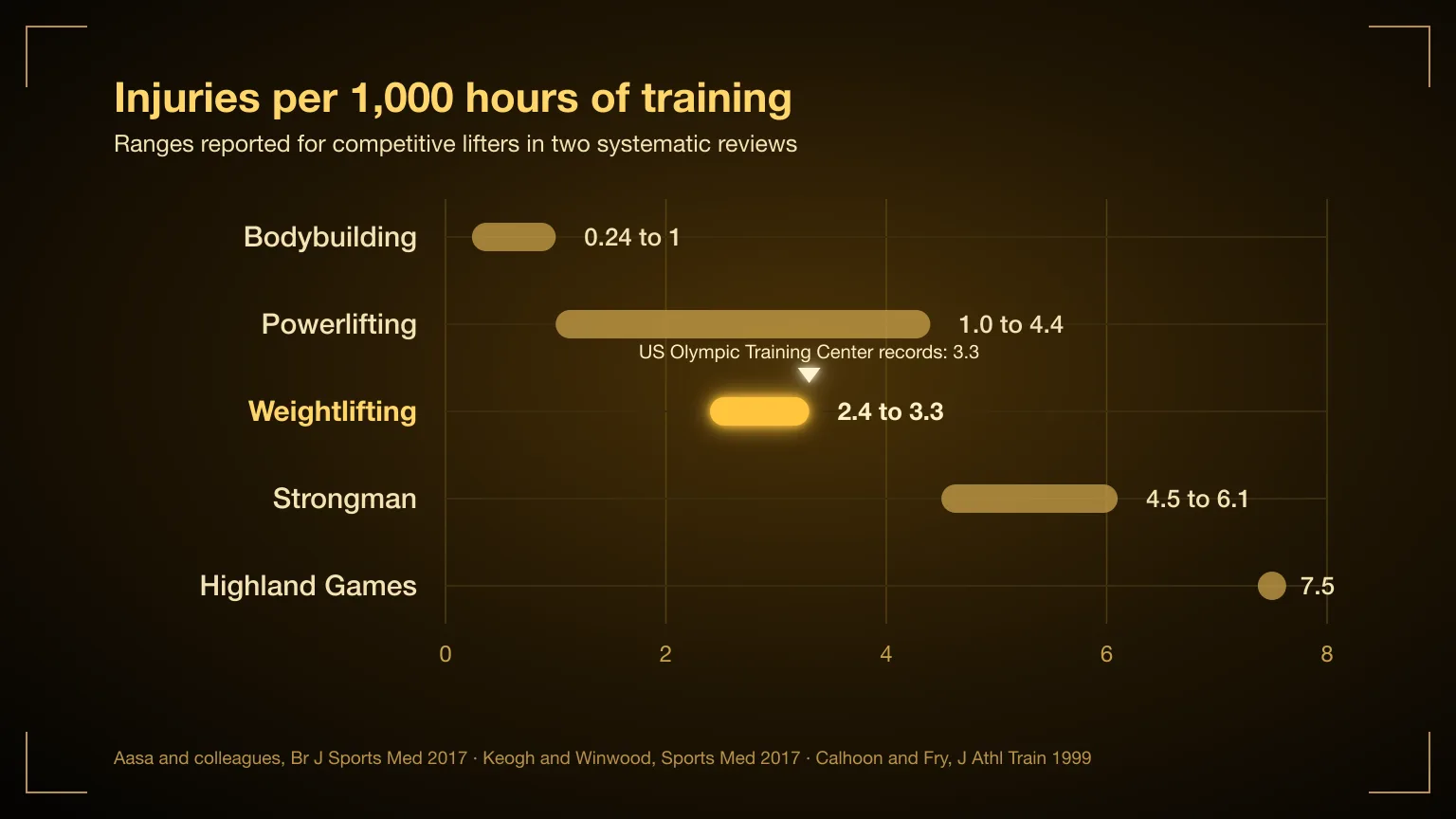
A review across the weight-training sports puts bodybuilding lowest at 0.24 to 1 injury per 1,000 hours and strongman at 4.5 to 6.1, with weightlifting in between. Most of the studies behind these numbers looked back at past injuries and few followed lifters forward, so read them as a guide to the size of the risk. Keep yours at the low end:
- Lift on bumper plates and learn to miss in week one. When the bar drifts in front, push it away and step back. When it drifts behind, let it go and jump forward. Nobody spots a snatch or a clean.
- End the set when a position changes, before you reach failure.
- Keep heavy singles for the test days in weeks 4 and 8.
- Warm up through the three positions with the empty bar before every session.
See a physician before you start if you have a heart condition, blood pressure that is not under control, a recent operation or joint pain that already limits you. Once you train, stop and get checked for pain that lasts more than a few days, sharp pain in a joint, numbness, tingling or swelling.
Find a coach and a club
A coach sees what your camera misses and fixes it in the same set. In the US, the USA Weightlifting coach directory and club finder lists coaches who hold a Level 1, Level 2, National, International or Senior International certification and who passed a criminal background screening and SafeSport training. In Great Britain, use the British Weightlifting club finder. Anywhere else, ask your national weightlifting federation for its club list.
On your first visit, check four things:
- The coach watches every set you lift in your first weeks and gives you one cue at a time.
- The gym has bumper plates and a platform or rubber floor where you can drop the bar.
- Your plan has written sets, reps and percentages.
- Lifters miss safely, and nobody grinds through ugly maxes.
No club near you? Book a few sessions with a certified coach, then send side-on video of each lift between sessions.
Start at any age
You can start in your 30s, 40s or later. In a survey of 958 Masters weightlifters aged 34 to 87, most trained 3 to 4 days a week in sessions of 1 to 2 hours, most had less than 5 years in the sport, and more than three-quarters of the women had started within the past 5 years (Huebner and colleagues). USA Weightlifting runs Masters competition from age 35 in 5-year age groups, under its amendments to the IWF rules. If you start older, keep the same plan and give each step of the progression an extra week whenever a position feels new.
Fix the mistakes beginners make
- You start from the floor in week one. The floor adds the hardest positions first. Earn each height from the hip down, and reach the floor in week 4.
- You bend your arms before your legs finish. Early arm bend steals the drive from your hips and legs. Snatch from the power position with one thought, legs first and arms after, until the bar floats up on long arms.
- You jump forward to catch the bar. Forward jumps come from a bar that swings away from your hips. Pull the bar back into your hips and land with it over the middle of your feet. In the 2017 World Championships data, the bar traveled farther back toward the lifter in the snatches that stayed up.
- You chase weight every session. Each new maximum teaches your body the positions of that day. Save heavy singles for weeks 4 and 8, and lift crisp doubles and triples in between.
- You skip squats. Greg Everett of Catalyst Athletics puts a balanced clean and jerk at 85 to 90% of the front squat, so a weak squat caps your lifts. Squat on all three days.
- You press out the finish. On the platform, a press-out makes the snatch or the jerk a no lift. Lock your arms as you land, and use overhead squats and snatch balances to make the fast lockout automatic.
Common questions
How long does it take to learn the Olympic lifts?
Plan on about 8 weeks to go from an empty bar to a snatch and a clean and jerk from the floor, with a coach. Four elite athletes learning the hang power clean twice a week gained jump power within 4 weeks and kept changing their technique for 169 days.
How many days a week should a beginner do Olympic weightlifting?
Three nonconsecutive days work well. The 2026 ACSM position stand found strength improved with at least 2 sessions a week, and three gives you more practice on two technical lifts.
Is Olympic weightlifting safe for beginners?
A 2017 systematic review counted 2.4 to 3.3 injuries per 1,000 hours of training, and the elite records show mostly strains and tendinitis. Lift on bumper plates, learn to miss, keep heavy singles to test days and work with a coach.
What weight should a beginner start with?
A PVC pipe, then the empty bar, 15 kg for women and 20 kg for men. From week 5, lift 65 to 75% of your technical max for doubles and triples.
Can you start Olympic weightlifting after 30 or 40?
Yes. In a survey of 958 Masters lifters aged 34 to 87, most had less than 5 years in the sport, and USA Weightlifting runs Masters competition from age 35.
Do you need a coach to start?
Find one if you can. Learners who heard spoken cues improved their hang power clean, while video on its own did not help. The USA Weightlifting coach directory and the British Weightlifting club finder list coaches and clubs near you.
Sources
- IWF Technical and Competition Rules and Regulations 2024 (copy hosted by the Polish Weightlifting Federation)
- Currier and colleagues, ACSM position stand on resistance training prescription, Medicine and Science in Sports and Exercise 2026
- Comfort and colleagues, NSCA position statement on weightlifting for sports performance, Journal of Strength and Conditioning Research 2023
- Suchomel, Comfort and Stone, Weightlifting pulling derivatives, Sports Medicine 2015
- Haug, Drinkwater and Chapman, Learning the hang power clean, Journal of Strength and Conditioning Research 2015
- Rucci and Tomporowski, Kinematic feedback and the hang power clean, Journal of Strength and Conditioning Research 2010
- Nagao and colleagues, Successful and unsuccessful snatch attempts among elite men, Sports 2019
- Aasa and colleagues, Injuries among weightlifters and powerlifters, British Journal of Sports Medicine 2017
- Calhoon and Fry, Injury rates and profiles of elite competitive weightlifters, Journal of Athletic Training 1999
- Keogh and Winwood, The epidemiology of injuries across the weight-training sports, Sports Medicine 2017
- Huebner and colleagues, The Masters athlete in Olympic weightlifting, PLOS ONE 2020
- USA Weightlifting, coach directory and club finder
- British Weightlifting, find a club
- USA Weightlifting, amendments to the IWF Technical Rules, 28 March 2025
- Greg Everett, Ask Greg: Improving Clean, Power Clean and Snatch, Catalyst Athletics 2018